
Late-night production deployments, urgent client deliverables, weekend production support, and relentless 12-hour shifts have become routine across India’s private corporate landscape. Yet, for millions of software engineers, operations executives, and corporate professionals, excessive working hours are accompanied by widespread confusion: “Is overtime legally mandatory in private companies? How is overtime pay calculated under Indian labor law? What is the ‘double ordinary wage rate’ rule? Why do IT companies rarely pay overtime and instead offer ‘Comp-Offs’? Are employees earning high salaries legally exempt from overtime protections? Can an employer terminate you for refusing to work on weekends?” Governed primarily by the Factories Act, 1948, respective State Shops and Commercial Establishments Acts, and the incoming Occupational Safety, Health and Working Conditions Code (OSH Code), Indian jurisprudence provides strict statutory ceilings on working hours and mandates premium pay for extra labor. In this definitive 2026 guide, we break down the exact mathematical formulas for overtime rules in Indian private companies, examine state-wise overtime rate variations, demystify managerial exemptions, evaluate Compensatory Off (Comp-Off) legalities, and outline your statutory remedies under Indian labor law.

Quick Summary: Overtime Realities in Indian Private Sector (2026)
Before analyzing state statutes, payroll deduction mathematics, and judicial precedents, review this executive overview of overtime regulations across private sector India:
| Statutory Dimension | Legal Standard under Indian Labor Statutes | Governing Legal Act | Corporate Application & Reality |
|---|---|---|---|
| Standard Daily Working Hours | Maximum 8 to 9 hours per day (excluding mandatory 30–60 minute meal intervals). | State Shops Acts & Factories Act (Sec 51/54) | Work performed beyond 9 hours on any single day legally constitutes overtime. |
| Standard Weekly Working Hours | Maximum 48 hours per week across a 5-day or 6-day working structure. | State Shops Acts & Factories Act (Sec 51) | Work performed beyond 48 hours in any rolling 7-day period triggers statutory overtime pay. |
| Statutory Overtime Pay Rate | Strictly mandated at 200% (twice / double) of the ordinary rate of wages. | Factories Act (Sec 59) & State Shops Acts | Double the employee’s hourly rate calculated on Basic Pay plus Dearness Allowance (DA). |
| Managerial / Supervisory Exemption | Employees in managerial, administrative, or confidential roles are exempt from overtime. | Section 3(1) of State Shops Acts | Used widely by IT firms to classify salaried engineers as managerial, though labor courts scrutinize actual job duties. |
| Compensatory Off (Comp-Off) | A substitute paid holiday granted in lieu of working on a weekly rest day or festival. | State Model Standing Orders & HR Policies | Common in IT/tech; must generally be encashed or availed within 30 to 60 days of accrual. |
| Maximum Overtime Cap | Quarterly overtime capped between 50 to 125 hours depending on the state statute. | State Rules & OSH Code Provisions | Employers cannot compel indefinite, continuous overtime that exceeds statutory quarterly ceilings. |
| Taxability of Overtime Wages | 100% Taxable as “Profits in lieu of Salary” under Section 17 of the Income Tax Act. | Income Tax Act, 1961 | Subject to standard TDS deductions under our New vs Old Tax Regime rules. |
The Legal Framework: Factories Act vs State Shops & Establishments Acts
In India, employee working hours and overtime compensations are primarily governed by two major statutory instruments:
- The Factories Act, 1948 (Section 59): Applies to manufacturing units, production plants, and industrial establishments. Section 59 explicitly mandates that where a worker works for more than 9 hours in any day or for more than 48 hours in any week, they are entitled to wages at the rate of twice their ordinary rate of wages.
- State Shops and Commercial Establishments Acts: Governs IT/ITES companies, software tech parks, consulting agencies, financial institutions, private banks, startups, and corporate commercial offices. Because labor is on the Concurrent List of the Indian Constitution, each state has enacted its own Shops Act defining exact overtime multiples and working limits.
State-Wise Statutory Overtime Rates and Daily Limits
While almost all major corporate states enforce the double wage rate (2x), the calculation bases and quarterly caps vary:
- Karnataka (Bangalore / IT Corridor): Under the Karnataka Shops and Establishments Act, 1961 (Section 8), no employee can work more than 9 hours a day or 48 hours a week. Overtime is payable at twice the ordinary rate of wages, and the total overtime hours cannot exceed 50 hours in any continuous period of 3 months.
- Maharashtra (Mumbai / Pune): Under the Maharashtra Shops and Establishments Act, 2017 (Section 15), daily work is capped at 9 hours and weekly work at 48 hours. Overtime is payable at double the normal rate of wages, capped at a maximum of 125 overtime hours per quarter.
- Delhi NCR (Delhi / Noida / Gurgaon): Under the Delhi Shops and Establishments Act, 1954 (Section 8), any work performed beyond 9 hours in a day or 48 hours in a week requires payment of overtime at double the ordinary wage rate.
- Tamil Nadu (Chennai / Coimbatore): Under the Tamil Nadu Shops and Establishments Act, 1947 (Section 14), overtime is mandated at twice the ordinary rate of wages for work performed beyond 8 hours a day or 48 hours a week.
- Telangana (Hyderabad Tech Hub): Governed by the Telangana Shops and Establishments Act, 1988, mandating 2x normal wages for hours exceeding 8 hours per day or 48 hours per week.
The Overtime Calculation Formula: Step-by-Step Payroll Mathematics
Under Indian labor law, the statutory term “ordinary rate of wages” is defined as the employee’s Basic Salary plus Dearness Allowance (DA) (and any standard cash allowances), strictly excluding house rent allowance (HRA), annual bonuses under the Payment of Bonus Act, and discretionary incentives.
Step 1: Calculating the Standard Hourly Wage Rate
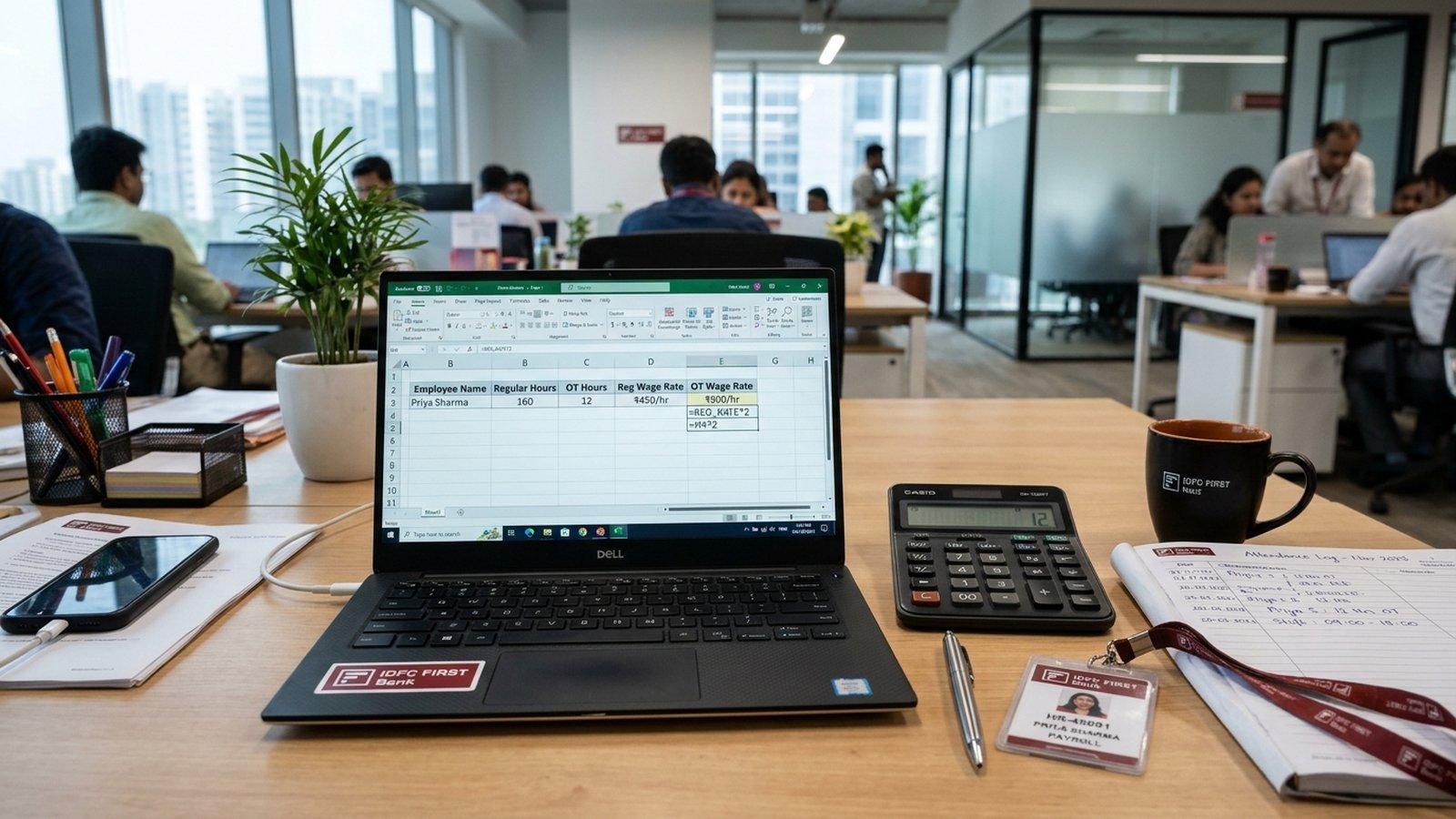
To determine the overtime rate, payroll specialists first convert the monthly eligible salary into an hourly wage based on 26 statutory working days per month and 8 standard working hours per day:
Daily Wage Rate = Monthly Eligible Salary (Basic + DA) ÷ 26 Days
Hourly Wage Rate = Daily Wage Rate ÷ 8 Hours
Step 2: Applying the Statutory 2x (Double) Multiple
Because the law mandates double the ordinary rate of wages, the statutory formula for overtime earnings is:
Overtime Rate Per Hour = Hourly Wage Rate × 2
Total Overtime Pay = Overtime Rate Per Hour × Total Overtime Hours Worked
Practical Examples Across Salary Tiers
| Monthly Basic + DA | Daily Wage Rate (Div / 26) | Standard Hourly Rate (Div / 8) | Overtime Rate (2x Hourly) | Payout for 20 Hours OT / Mo |
|---|---|---|---|---|
| ₹26,000 / month | ₹1,000 / day | ₹125 / hour | ₹250 / hour | 20 × ₹250 = ₹5,000 |
| ₹39,000 / month | ₹1,500 / day | ₹187.50 / hour | ₹375 / hour | 20 × ₹375 = ₹7,500 |
| ₹52,000 / month | ₹2,000 / day | ₹250 / hour | ₹500 / hour | 20 × ₹500 = ₹10,000 |
| ₹78,000 / month | ₹3,000 / day | ₹375 / hour | ₹750 / hour | 20 × ₹750 = ₹15,000 |
Notice: If an employer calculates daily wages by dividing by 30 or 31 calendar days rather than 26 working days, it dilutes the hourly denominator. Under judicial precedents, dividing by 26 days is the standard legal formula across Indian labor courts.

The “Managerial & Supervisory” Exemption in Indian IT Companies
If the law clearly mandates double wage rates for overtime, why do Indian IT service companies (TCS, Infosys, Wipro, HCL, Cognizant) and tech startups rarely pay cash overtime to software engineers?
The answer lies in the statutory exemption clauses built into State Shops and Establishments Acts. For example, Section 3(1) of the Karnataka Shops and Establishments Act explicitly states that the Act does not apply to “persons employed in any establishment in a position of management or confidential character.”
How Corporations Apply This Exemption
- Designation Inflation: Companies assign professional titles like “Associate Consultant,” “Systems Engineer,” “Senior Analyst,” or “Team Lead” and insert contractual clauses in appointment letters stating: “Your compensation is inclusive of all hours necessary to fulfill your responsibilities; no overtime compensation is payable.”
- The CTC Structure Reality: In modern CTC compensation packages, companies provide flexi-allowances, performance bonuses, and special allowances rather than hourly tracking.
What Indian Courts Have Ruled: Job Content Over Designation
The Supreme Court of India has established in landmark rulings (including Ved Prakash Gupta vs. Delton Cable Co. and National Association of Software and Service Companies (NASSCOM) guidelines) that designation alone does not determine managerial status—the nature of actual duties performed is the ultimate test:
- If an employee writes code, runs software tests, resolves Jira support tickets, or performs operational tasks without autonomous power to hire, fire, approve leaves, or make administrative financial commitments, they are legally classified as a “workman” or non-exempt employee regardless of a fancy corporate title.
- Such technical employees are legally entitled to overtime protections under state labor statutes. However, because individual legal action is rare due to career risks, companies rely on Compensatory Off (Comp-Off) systems instead.
Compensatory Off (Comp-Off) vs Cash Overtime: Legal Realities
Rather than disbursing cash overtime at 200%, the vast majority of Indian IT and corporate firms implement an internal Compensatory Off (Comp-Off) Policy. How does this align with Indian law?
| Dimension | Statutory Cash Overtime (Law) | Corporate Compensatory Off (Comp-Off) |
|---|---|---|
| Compensation Form | Cash Payment at 2x hourly rate in the next monthly payroll run. | Extra Paid Leave Credit added to the employee’s HRMS leave portal. |
| Accrual Basis | Calculated on actual excess hours worked beyond 8 or 9 hours/day. | Typically granted for full-day or half-day work performed on weekends/holidays. |
| Validity Period | Immediate statutory liability; cannot be lapsed or forfeited. | Must generally be utilized within 30 to 60 days of accrual; lapses thereafter. |
| Encashment at Exit | Unpaid overtime is recoverable as wage arrears in FnF settlement. | Lapsed comp-offs are rarely encashable unless explicitly specified in leave policy. |

Can a Company Force You to Work Overtime or on Weekends?
Under Indian labor law, an employer cannot arbitrarily compel an employee to work continuous overtime without consent or statutory justification:
- Mandatory Weekly Rest Day: Under Section 52 of the Factories Act and equivalent clauses in State Shops Acts, every employee is entitled to at least one full day of rest in every period of 7 days (usually Sunday, or an alternative designated rest day).
- Compensatory Rest Mandate: If an employee is required to work on their weekly rest day due to an acute business emergency, the employer is legally obligated to provide a compensatory holiday within 3 days immediately preceding or following the rest day, or within the same month.
- Can Refusing Overtime Lead to Termination? If an employee refuses overtime beyond statutory working limits (e.g., refusing to work a 14-hour shift or refusing to work on scheduled annual leave governed by state leave policy rules), the employer cannot legally terminate the employee for misconduct. Summary termination for refusing unlawful excess hours constitutes wrongful dismissal and illegal retrenchment under Indian labor laws.
Night Shift Regulations and Safety Mandates for Women Employees
With thousands of multinational GCCs and BPOs operating 24/7 across Bangalore, Hyderabad, Pune, and Gurgaon, state governments have introduced stringent regulations governing night shifts (typically between 8:00 PM and 6:00 AM):
- Written Consent Requirement: Women employees can only be scheduled for night shifts if they have provided prior voluntary written consent.
- Mandatory Door-to-Door Transportation: Under State Shops and Establishments rules, the employer must provide free, secure, GPS-tracked transportation with security escorts directly from the office to the doorstep of the employee’s residence for all night-shift employees.
- Security & POSH Measures: The facility must maintain full-time female security guards, functional CCTV surveillance, emergency SOS buttons, and active Internal Committees compliant with the POSH Act regulations.
Frequently Asked Questions (FAQs)
1. Can salaried software engineers in Indian IT companies claim overtime pay?
Technically, yes, if the engineer is not performing managerial or administrative duties (such as performance appraisals, hiring, or budget approvals). However, most IT employment contracts explicitly state that compensation is based on deliverables rather than fixed hours and classify professionals under exempt categories. Instead of cash overtime, companies provide Compensatory Offs (Comp-Offs) or On-Call / Shift Allowances (typically ₹1,000 to ₹3,000 per on-call weekend).
2. Is overtime pay taxable under Indian income tax laws?
Yes, 100% of overtime earnings are taxable. Under the Income Tax Act, 1961, overtime pay is categorized as part of “Salary” under Section 17. The employer adds overtime earnings to your gross taxable salary for that payroll month and deducts TDS according to your applicable slab rates under the New or Old Tax Regime.
3. What is the maximum overtime an employer can legally ask an employee to work?
Under the Factories Act and major State Shops Acts (e.g., Karnataka, Delhi, Maharashtra), overtime is strictly capped. An employee cannot be asked to work more than 10 to 10.5 total hours on any single day (including overtime), and total overtime hours cannot exceed 50 to 125 hours in any quarter (3-month window). Forcing hours beyond these statutory limits is a punishable offense under state labor inspection rules.
4. What happens to accumulated Comp-Offs when an employee resigns?
Unlike statutory Earned Leave (Privilege Leave), which must legally be encashed during the Full and Final (FnF) settlement, Compensatory Offs are governed strictly by company HR policy. Most corporate handbooks state that unused comp-offs lapse after 30 to 60 days and cannot be encashed for monetary payout upon exit. However, employees can request HR to adjust active comp-off days against their notice period to secure an earlier relieving date.
5. Where can an employee file a complaint if an employer refuses to pay overtime?
If an employee in a non-managerial capacity has documented timesheet proof of approved overtime work that was refused payment, they can file a formal claim before the Inspector under the State Shops and Commercial Establishments Act or the Labor Commissioner / Authority under the Payment of Wages Act. The labor authority can direct payment of unpaid wages along with statutory penalty compensation up to ten times the unpaid amount.