
A safe, dignified, and harassment-free workplace is not an optional corporate perk—it is an enforceable constitutional guarantee. Across India’s rapidly growing IT corridors, financial hubs, retail chains, and startup hubs, corporate professionals frequently encounter complex workplace dynamics: “What constitutes sexual harassment under Indian law? Who sits on the Internal Committee (IC)? How do you file a formal complaint without jeopardizing your career? What is the legally binding 90-day inquiry timeline? What interim protections exist if your reporting manager is the respondent? Can an employer terminate someone falsely accused?” Enacted under the landmark framework of the Sexual Harassment of Women at Workplace (Prevention, Prohibition and Redressal) Act, 2013 (POSH Act), Indian labor jurisprudence places strict civil liabilities and severe operational penalties on employers who fail to maintain robust redressal mechanisms. In this comprehensive 2026 guide, we break down the statutory architecture of the POSH act in Indian private companies, examine the mandatory composition of the Internal Committee, provide a step-by-step complaint walkthrough, demystify interim relief measures, and analyze critical legal safeguards for both complainants and respondents.

Quick Summary: POSH Act Realities in Indian Private Sector (2026)
Before examining statutory procedures, evidence gathering, and court precedents, review this executive overview of key POSH obligations across private companies in India:
| Statutory Dimension | Legal Mandate under POSH Act, 2013 | Governing Clause | Impact on Corporate Employees |
|---|---|---|---|
| Establishment Threshold | Mandatory for every office/branch employing 10 or more employees (regular, contract, intern, or consultant). | Section 4(1) | Must constitute an Internal Committee (IC) at each administrative branch or regional office. |
| Committee Composition | Presiding Officer (Senior Woman), minimum 2 Employee Members committed to women’s causes, 1 External Independent Member (NGO/Advocate). Minimum 50% women representation. | Section 4(2) | Prevents corporate management bias; external member ensures unbiased compliance with natural justice. |
| Limitation Period | Formal written complaint must be submitted within 3 months from date of incident (extendable by 3 months with recorded justification). | Section 9(1) | Timely filing is essential; documented digital communications preserve admissibility. |
| Inquiry Timeline | Inquiry must be concluded strictly within 90 days from commencement; IC inquiry report submitted within 10 days thereafter. | Section 11 & 13 | Guarantees swift resolution without indefinite bureaucratic delays or administrative freezes. |
| Interim Relief Powers | IC can recommend immediate transfer, up to 3 months paid leave (not deducted from annual leave quota), or restraining respondent from appraisals. | Section 12 | Protects complainant from workplace hostility, intimidation, or negative performance evaluation. |
| Confidentiality Mandate | Strict prohibition against disclosing identities of complainant, respondent, or witnesses. Section 17 penalty applies for leaks. | Section 16 & 17 | Shields personal reputations; violations attract disciplinary fines under corporate service rules. |
| Protection Against False Claims | Malicious, knowingly forged, or fabricated complaints attract disciplinary penalties under service rules (Section 14). | Section 14 | Inability to substantiate a genuine claim does not constitute a malicious complaint. |
What Constitutes Sexual Harassment Under Indian Law?
Under Section 2(n) of the POSH Act, sexual harassment includes any one or more of the following unwelcome acts or behavior (whether directly or by implication):
- Physical Contact & Advances: Unwelcome touching, brushing against someone, physical intimidation, or invading personal space without consent.
- Demand or Request for Sexual Favors: Quid pro quo harassment where career advancement, positive performance ratings (PIP exemptions), promotions, or job retention are explicitly or implicitly conditioned on compliance.
- Sexually Colored Remarks: Unsolicited commentary on an employee’s body, clothing, marital status, or personal intimate life, whether in person, via Slack, Teams, or WhatsApp.
- Showing Pornography: Displaying sexually suggestive imagery, videos, offensive memes, or explicit screensavers in physical or virtual workspaces.
- Any Other Unwelcome Physical, Verbal, or Non-Verbal Conduct: Persistent suggestive staring, intrusive personal questioning, stalking, or sending unsolicited romantic gifts.
The “Extended Workplace” Doctrine in Hybrid & IT Cultures
In modern corporate India, the workplace is no longer confined to physical corporate cubicles. Under Section 2(o) of the Act, the “extended workplace” includes:
- Official company transportation (cabs, shuttles, flights booked for client visits).
- Client offices, vendor facilities, offsite retreats, and corporate conferences.
- After-hours team dinners, happy hours, and informal corporate networking gatherings sponsored or organized by team leadership.
- Virtual Work Environments: Official Slack workspaces, Microsoft Teams chats, Zoom/Google Meet video calls, corporate emails, and even personal WhatsApp/social media chats if the communication arises from the employment relationship.
Internal Committee (IC) Composition: Who Has the Authority to Judge?
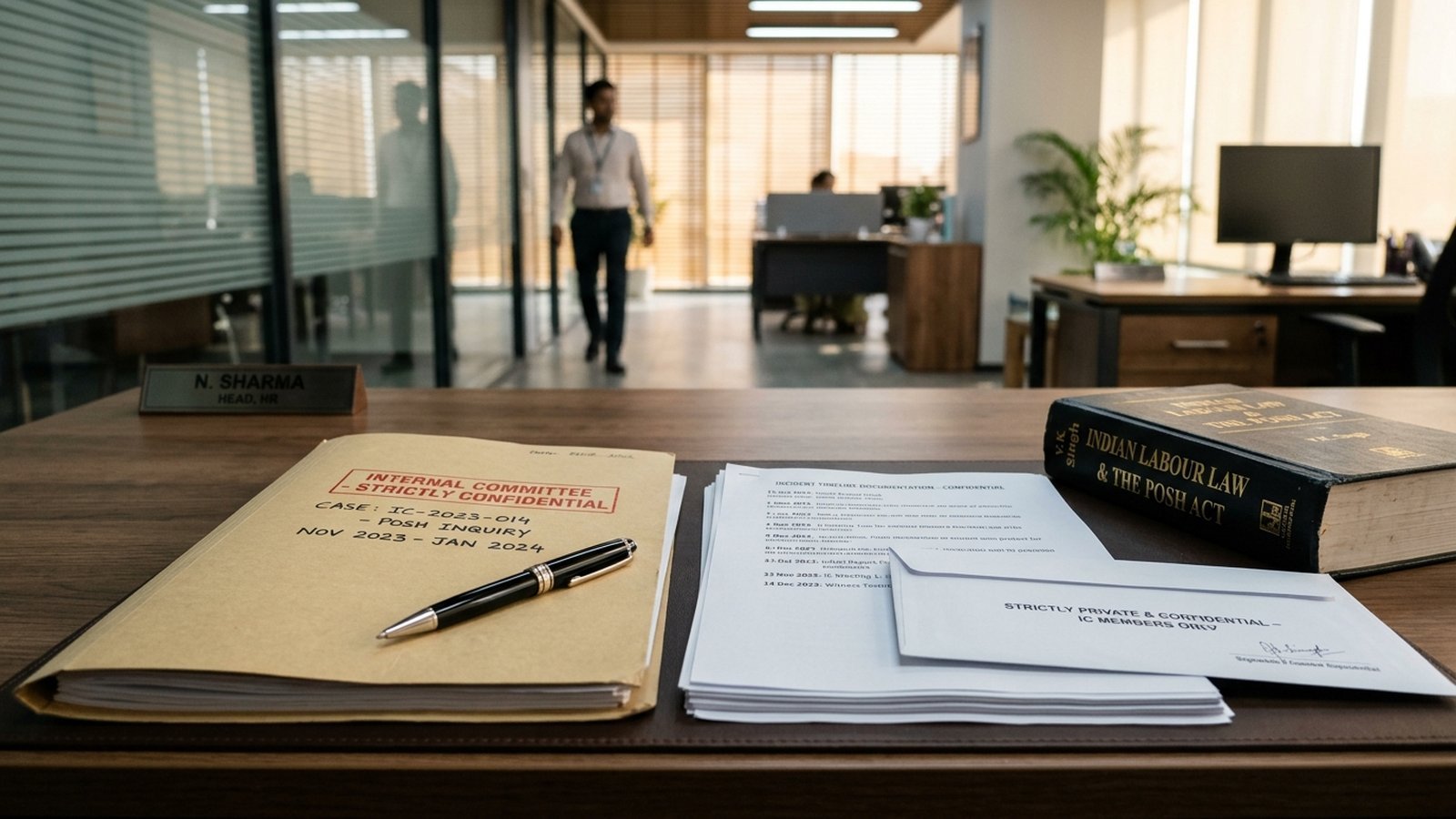
Every private company, IT services firm, LLP, startup, and commercial establishment employing 10 or more persons is legally mandated to constitute an Internal Committee (IC) by written administrative order. To eliminate managerial favoritism and institutional bias, the POSH Act enforces a rigorous four-pillar composition formula:
- Presiding Officer: Must be a woman employed at a senior level at the workplace from amongst the employees. If a senior woman is not available at that specific branch, she must be nominated from another office or administrative unit of the same employer.
- Employee Members: Not less than two members from amongst employees preferably committed to the cause of women or who have had experience in social work or have legal knowledge.
- External Member: One independent member from amongst non-governmental organizations (NGOs) or associations committed to the cause of women, or a person familiar with issues relating to sexual harassment (such as an advocate specializing in labor and POSH jurisprudence).
- 50% Gender Quota: At least one-half of the total members so nominated must be women.
Legal Consequence of Flawed IC Constitution: The Supreme Court of India in multiple decisions has ruled that an inquiry conducted by an improperly constituted IC (such as missing an external member or lacking 50% female representation) is void ab initio (invalid from the beginning). Any disciplinary termination or action based on an invalid IC report will be quashed by labor courts, exposing the employer to substantial back-pay and damages under statutory retrenchment laws.
Step-by-Step: The Formal POSH Complaint Filing Process
Navigating the formal complaint process requires procedural discipline to ensure that your claims are legally unimpeachable. Follow these essential chronological steps:
Step 1: Drafting & Submitting the Formal Written Complaint
An aggrieved woman can file a written complaint to the Internal Committee within 3 months from the date of the incident (or within 3 months from the last incident in case of a series of events). If the complainant is unable to file due to physical or mental incapacity, her legal heir, co-worker, or guardian may file with her written consent.
- Number of Copies: Under Rule 7(1) of the POSH Rules, 2013, the complainant must submit six copies of the complaint along with supporting documents and names and addresses of witnesses (or submit via secure designated electronic IC email portals in digitized corporations).
- Essential Details to Include: Exact dates, times, physical locations or virtual platforms, verbatim quotes of statements made, names of direct or indirect witnesses, and attachments of supporting digital evidence (screenshots, call logs, emails).
Step 2: Option for Informal Conciliation
Before initiating a formal adversarial inquiry, Section 10 allows the IC, at the specific written request of the aggrieved woman, to take steps to settle the matter between her and the respondent through conciliation.
Crucial Statutory Restriction: Under Section 10(1) proviso, no monetary settlement can be made the basis of conciliation. Conciliation typically results in a formal written apology, reassignment of reporting hierarchy, or behavioral undertakings. If conciliation is chosen, no further inquiry is conducted. However, if the respondent breaches any term of the conciliation agreement, the IC must immediately reopen and conduct a full formal inquiry.

The 90-Day Inquiry Timeline & Evidentiary Standards
When a formal inquiry commences, the Internal Committee acts as a quasi-judicial body vested with the powers of a Civil Court under the Code of Civil Procedure, 1908 (CPC) regarding summoning witnesses, examining them under oath, and compelling the production of documents. The inquiry must strictly adhere to the following statutory calendar:
| Inquiry Stage | Statutory Window | Legal Action Required |
|---|---|---|
| Notice to Respondent | Within 7 working days of complaint receipt | IC serves one copy of the complaint and evidence bundle to the respondent employee. |
| Respondent’s Written Response | Within 10 working days of notice receipt | Respondent must submit a detailed written defense, list of counter-witnesses, and rebuttal evidence. |
| Oral Hearings & Cross-Examination | Within 60 to 75 days | Both parties present statements. Cross-examination is conducted via written questionnaires submitted to the IC to prevent intimidating direct badgering. |
| Final Inquiry Conclusion | Strict maximum of 90 days from commencement | All witness depositions, electronic audit logs, and evidentiary verifications must conclude. |
| Inquiry Report Submission | Within 10 days of inquiry conclusion | IC provides its written findings and recommended penalties to the Employer and both parties. |
| Employer Implementation | Within 60 days of report receipt | Management must enforce recommended penalties (termination, demotion, written apology, or salary deduction). |
Principles of Natural Justice & Legal Representation Rules
Under Section 11, the IC must conduct the inquiry in accordance with the principles of natural justice—both parties must be granted equal opportunity to present their case, inspect documents, and respond to allegations. Key Rule on Lawyers: Under Section 11(2) and Rule 7(6), neither party is permitted to bring an external legal practitioner or practicing advocate to represent them during IC hearings. This ensures the proceedings remain non-intimidating, administrative, and accessible.
Interim Relief: Employee Protections During an Active Inquiry
One of the greatest fears for employees reporting harassment is workplace retaliation, hostility, or vindictive performance appraisal downgrades while the 90-day inquiry is ongoing. Under Section 12, the IC possesses autonomous statutory power to recommend immediate interim relief upon the written request of the aggrieved woman:
- Transfer of Either Party: Reassigning either the aggrieved woman or the respondent to another department, team, project, or regional branch office.
- Up to 3 Months Paid Leave: Granting the complainant paid leave for up to three months. Crucially, this special leave is completely over and above the employee’s regular statutory annual, casual, or medical leave balances governed by state leave policy rules.
- Reporting Hierarchy Restructuring: Restraining the respondent from supervising the complainant, reviewing her code/deliverables, or participating in her annual appraisal cycles.
- Restraining Orders: Ordering the respondent to cease all direct or indirect communication, physical proximity, or contact with the complainant.
Under Section 12(3), the employer is legally obligated to implement these interim recommendations immediately and report compliance back to the Internal Committee.
Safeguards Against Malicious Claims & Rights of the Accused
While the POSH Act is designed to protect vulnerable employees, the legislature recognized the catastrophic damage that fabricated or vindictive allegations can inflict on an innocent professional’s career, mental health, and livelihood. Section 14 outlines specific provisions regarding false complaints:
Section 14: Penalties for Malicious Claims and False Evidence
If the Internal Committee concludes after a thorough inquiry that the allegation was made with malicious intent or that the complainant or any witness submitted forged, doctored, or fabricated documents, the IC may recommend that the employer take disciplinary action against the complainant under corporate service rules.
Crucial Legal Distinction: The statutory proviso to Section 14 clarifies that mere inability to substantiate a complaint or provide adequate corroborating evidence does not equate to a malicious complaint. Malice requires positive, clear evidence demonstrating deliberate conspiracy, extortion, or retaliatory fabrication.
Impact on Resignations, FnF, and Future Background Verification
Can an employee resign while facing an active POSH inquiry? Under standard corporate employment contracts, employers reserve the right to freeze the notice period and reject resignation retraction while an IC inquiry is underway, as explored in our resignation withdrawal rules guide. If an employee is found guilty of gross sexual misconduct and terminated:
- The exit is classified as “Involuntary Termination for Cause”.
- Under Section 4(6) of the Payment of Gratuity Act, gratuity can be partially or wholly forfeited to offset financial compensation awarded to the victim, as explained in our FnF settlement guide.
- Future prospective employers conducting rigorous background verification (BGV) will receive an adverse clearance flag regarding termination for behavioral misconduct.

Penalties for Corporate Non-Compliance: What Companies Risk
Companies that neglect POSH compliance face severe legal and financial repercussions under Section 26 of the Act:
- Monetary Fines: Failure to constitute an Internal Committee, failure to act on IC recommendations, or contravening POSH provisions attracts a direct statutory fine of up to ₹50,000.
- Cancellation of Business License: Repeated violations result in double the penalty and potential cancellation, withdrawal, or non-renewal of commercial licenses, shop registrations, or operating permits issued by government authorities.
- Mandatory Annual Reporting: Companies must disclose the number of POSH complaints filed, disposed of, and pending in their annual reports filed with the District Officer and Registrar of Companies (ROC) under the Companies Act, 2013.
Frequently Asked Questions (FAQs)
1. Are men protected under the POSH Act in India?
The central POSH Act, 2013 is strictly gender-specific and defines an “aggrieved woman” as the beneficiary of the statutory complaint redressal mechanism. However, progressive Indian IT firms, multinational corporations, and leading tech companies have adopted gender-neutral internal anti-harassment policies. Male and non-binary employees experiencing sexual harassment can file formal grievances with HR or Ethics Committees under internal company codes of conduct, which follow inquiry procedures modeled after POSH guidelines.
2. Can an employee file a POSH complaint for harassment occurring on WhatsApp or personal social media?
Yes, absolutely. Under the established judicial doctrine of the “notional and extended workplace,” any digital communication between colleagues that is sexually explicit, suggestive, hostile, or unwelcome falls within the jurisdiction of the Internal Committee, regardless of whether the messages were exchanged after work hours, on personal mobile phones, or across private WhatsApp/Instagram chats.
3. What happens if someone leaks the details of a POSH complaint to colleagues or the press?
Under Section 16 of the POSH Act, disclosing the identity, address, or details of the complainant, respondent, or witnesses is strictly prohibited. Under Section 17, any person (including committee members, HR personnel, or co-workers) who breaches confidentiality is liable to immediate penalty in accordance with the corporate service rules, including substantial monetary deductions, suspension, or termination.
4. Can an employee file a POSH complaint if the incident occurred more than 3 months ago?
Yes. While the standard limitation period under Section 9(1) is 3 months, the proviso allows the Internal Committee to extend the deadline by an additional 3 months (totaling 6 months) if satisfied that exceptional circumstances (such as medical trauma, hospitalization, or threats of retaliation) prevented the complainant from filing earlier. Furthermore, in cases of continuous or recurring harassment, the 3-month clock begins from the date of the most recent incident.
5. Where can an employee appeal if they are dissatisfied with the Internal Committee’s decision?
Under Section 18 of the POSH Act, any person aggrieved by the recommendations of the Internal Committee or non-implementation by the employer can file a formal judicial appeal before an Industrial Tribunal or Labor Court within 90 days of the inquiry report. Alternatively, writ petitions can be submitted before the State High Court under Article 226 of the Constitution if fundamental principles of natural justice were violated during the inquiry.