Executive Technical Interview Blueprint (2026 Edition)
- The Evaluation Paradigm: Unlike automated coding assessments, technical interviews evaluate thought process, architectural clarity, and communication rather than just syntax correctness. Panels want to see how you dissect ambiguity and justify trade-offs.
- The 4 Core CS Pillars: Over 70% of fresher technical questions in Tier-1 Indian IT firms (TCS, Infosys, Accenture, Cognizant, Wipro, Capgemini) originate from 4 standard academic subjects: Object-Oriented Programming (OOPs), Database Management Systems (DBMS & SQL), Operating Systems (OS), and Computer Networks (CN).
- The Project Defense Filter: Your final-year capstone project is the primary anchor of the technical round. Panels use it to verify whether you wrote real code or purchased a dummy project. Using the STAR-Tech Framework guarantees a structured, high-conviction answer.
- DSA Expectations by Hiring Tier: Mass-recruitment roles (3.5–4.5 LPA) require clean array/string logic, two-pointers, and linked lists. Differential & digital roles (7.0–12.0 LPA) mandate trees, graphs, dynamic programming, and system design fundamentals.
Having successfully cleared the high-elimination campus & off-campus aptitude assessment round, you have earned a seat in the most decisive stage of the recruitment process: the Technical Interview.
For freshers and early-career software engineers across India, the technical interview is often perceived as an intimidating trial of rapid-fire syntax memorization. In reality, technical panels at leading Indian IT service giants, global capability centers (GCCs), and product companies are rarely looking for walking compiler documentation. They are looking for candidates who demonstrate strong foundational engineering intuition, rigorous problem-solving logic, clean coding discipline, and authentic project ownership.
Whether you are preparing for a virtual video assessment via Microsoft Teams or an on-campus face-to-face panel in Bengaluru, Pune, Hyderabad, or Gurgaon, this definitive 2026 handbook provides the exact technical questions, working code examples, SQL query templates, project defense frameworks, and company-specific benchmarks needed to secure your selection.

Table of Contents
- Technical Interview Round Matrix Across Indian IT Giants
- Core CS Pillar 1: Object-Oriented Programming (OOPs) Masterclass
- Core CS Pillar 2: DBMS & Real-World SQL Query Scenarios
- Core CS Pillar 3: Operating Systems & Computer Networks Essentials
- Data Structures & Algorithms (DSA): High-Yield Interview Patterns
- The STAR-Tech Framework: Mastering Your Final-Year Project Viva
- The ‘Zero-Knowledge’ Protocol: How to Handle Questions You Don’t Know
- Smart Questions to Ask the Technical Interviewer at the End
- Frequently Asked Questions (FAQ) with Schema Markup
1. Technical Interview Round Matrix Across Indian IT Giants (2026)
Different recruiters in India evaluate technical proficiency through varying lenses. Mass-hiring service firms emphasize fundamental syntax and database queries, whereas digital and specialist tiers test algorithmic complexity and system design.
| Company & Hiring Tier | Package (CTC) | Primary Technical Focus Areas | Live Coding Requirement | Interview Duration |
|---|---|---|---|---|
| TCS Ninja | 3.36 LPA | C/Java/Python basics, OOPs concepts, basic SQL, Project overview | Basic (Syntax / Palindrome / Fibonacci) | 25–35 Mins |
| TCS Digital / Prime | 7.0–9.0+ LPA | Advanced DSA (Trees, Graphs, DP), Cloud/AI concepts, System architecture | Mandatory (Optimized O(N) solutions) | 45–60 Mins |
| Infosys Systems Engineer (SE) | 3.6–4.0 LPA | OOPs in depth, DBMS Normalization, SQL Joins, OS Paging & Deadlocks | Pseudo-code & String/Array manipulation | 30–40 Mins |
| Infosys DSE / Specialist Prog. | 6.5–9.5 LPA | Competitive programming, Trees, Recursion, Time-space complexity proofs | Rigorous (2-3 DSA Problems on HackerRank) | 45–60 Mins |
| Accenture ASE / Advanced ASE | 4.5–6.5 LPA | Technical troubleshooting, Software Development Life Cycle (SDLC), SQL, Project deep-dive | Code logic explanation & debugging | 30–45 Mins |
| Cognizant GenC / GenC Next | 4.0–6.75 LPA | Core Java/Python, Web Architecture, REST APIs, Database schema design | Live screen-share coding | 35–50 Mins |
To understand how compensation tiers and promotions scale in this sector, review our comprehensive analysis on Average Fresher Salaries Across Major Indian Sectors and the complete IT Services Career Roadmap in India. Furthermore, if your campus placement drive conducts an elimination speaking round prior to technical screening, master winning initiation scripts and topic arguments with our guide to Group Discussion (GD) Topics, Rules & Winning Strategies.
2. Core CS Pillar 1: Object-Oriented Programming (OOPs) Masterclass
Regardless of whether your resume lists C++, Java, or Python, technical interviewers invariably dedicate 10 to 15 minutes to probing your understanding of Object-Oriented Programming. Memorizing dictionary definitions is insufficient; you must be prepared to articulate real-world analogies, code implementations, and design trade-offs.
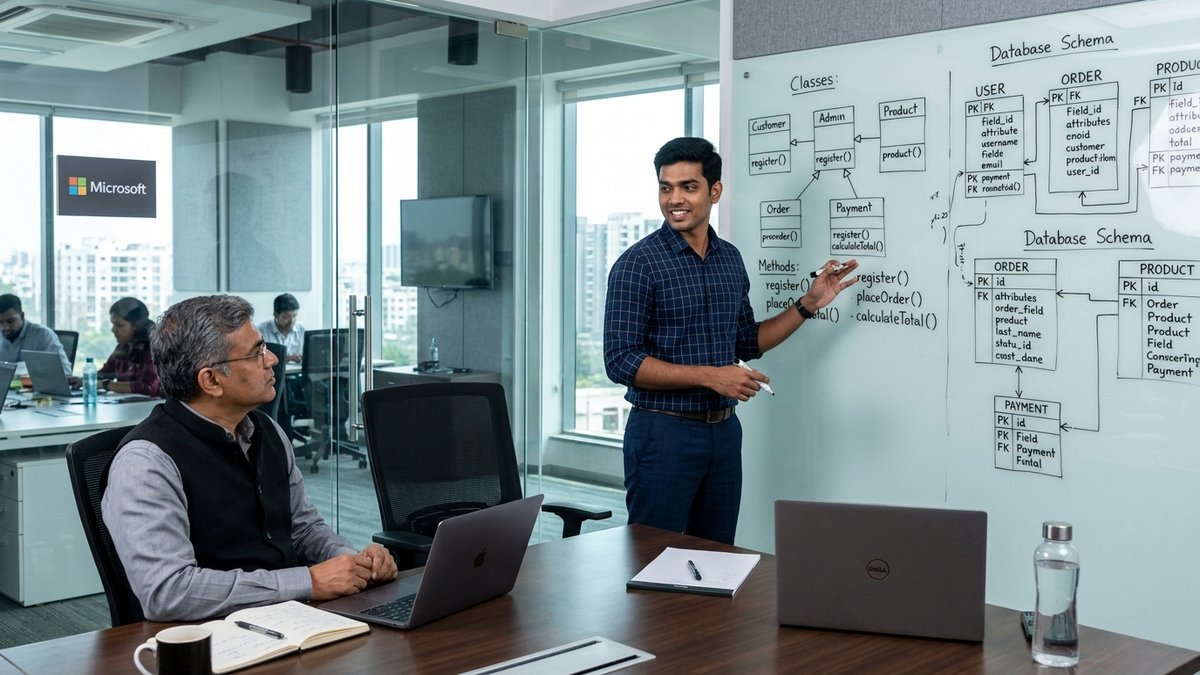
The 4 Pillars of OOPs (How to Explain Them to an Interviewer)
1. Encapsulation (Data Hiding)
Core Definition: Wrapping data (variables) and code (methods) together as a single unit, and restricting direct external access to object internals using private access specifiers with public getter and setter methods.
Real-World Analogy: A medical capsule contains various therapeutic chemicals enclosed inside a protective gelatin shell. The patient consumes the capsule without directly interacting with or contaminating the loose medicinal powder inside.
Code Concept: A BankAccount class with private double balance; where balance can only be modified via a validated public void deposit(double amount) method, preventing arbitrary balance corruption.
2. Abstraction (Hiding Complexity)
Core Definition: Displaying only essential features of an object to the user while concealing the underlying complex operational mechanics. Achieved in Java via abstract classes and interfaces.
Real-World Analogy: When pressing the accelerator pedal in an automobile, the vehicle accelerates. The driver does not need to manage fuel injection timing, valve compression ratios, or spark plug firing sequences.
Crucial Difference vs Encapsulation: Encapsulation is data protection (hiding implementation details using access modifiers). Abstraction is complexity reduction (hiding implementation completely to focus on what the object does rather than how it does it).
3. Inheritance (Code Reusability & Hierarchy)
Core Definition: The mechanism by which one class acquires the properties and behaviors (fields and methods) of another parent class using the extends keyword.
The Diamond Problem in Java: Why does Java not support Multiple Inheritance with classes? If Class C extends both Class A and Class B, and both parents define an identical display() method, the compiler faces ambiguity regarding which method implementation to invoke. Java avoids this ambiguity by disallowing multiple class inheritance while allowing a single class to implement multiple interfaces.
4. Polymorphism (Many Forms)
Compile-Time (Static) Polymorphism: Method Overloading. Multiple methods in the same class have the same name but different signatures (parameter types or counts). Resolved at compile-time by the compiler.
Run-Time (Dynamic) Polymorphism: Method Overriding. A child class provides a specialized implementation of a method declared in its parent class. Resolved at run-time using Dynamic Method Dispatch based on the actual object type created in memory.
3. Core CS Pillar 2: DBMS & Real-World SQL Query Scenarios
Every software system interacts with persistent storage. In Indian IT technical rounds, database knowledge is tested through two lenses: conceptual theory (normalization, ACID, indexing) and live SQL query authoring.
Critical DBMS Theoretical Concepts
- ACID Properties: Atomicity (entire transaction completes or rolls back), Consistency (data maintains schema integrity constraints), Isolation (concurrent transactions execute independently without dirty reads), and Durability (committed data survives server crashes).
- Database Normalization: The systematic process of structuring relational tables to eliminate data redundancy and prevent Insertion, Update, and Deletion anomalies.
- 1NF: Table cells contain single, atomic values; no repeating column groups.
- 2NF: In 1NF + all non-key attributes are fully functionally dependent on the entire Primary Key (no partial dependencies).
- 3NF: In 2NF + no transitive dependencies (non-key attributes depend only on the primary key, not on another non-key attribute).
- Database Indexing (B-Trees / B+ Trees): An index creates an ordered data structure that allows the query engine to locate records in
O(log N)time rather than performing full sequential table scansO(N). Trade-off: AcceleratesSELECTqueries but slows downINSERT,UPDATE, andDELETEoperations due to index rebuilding overhead.
Top 5 SQL Queries Tested in Every Technical Round
SELECT MAX(salary) FROM Employee
WHERE salary < (SELECT MAX(salary) FROM Employee);
— Modern Enterprise Solution using Dense_Rank() (Handles duplicate salaries):
WITH RankedSalaries AS (
SELECT emp_id, emp_name, salary,
DENSE_RANK() OVER (ORDER BY salary DESC) AS ranking
FROM Employee
)
SELECT emp_name, salary FROM RankedSalaries WHERE ranking = 2;
— 2. Find Duplicate Records and Their Occurrences
SELECT email, COUNT(*) AS count
FROM Users
GROUP BY email
HAVING COUNT(*) > 1;
— 3. INNER JOIN vs LEFT JOIN Demonstration
— Retrieve all employees and their department names (including employees without a department)
SELECT E.emp_name, D.dept_name
FROM Employee E
LEFT JOIN Department D ON E.dept_id = D.dept_id;
4. Core CS Pillar 3: Operating Systems & Computer Networks Essentials
Operating Systems and Networks validate your understanding of how software interfaces with hardware and internet infrastructure. Interview panels use these subjects to separate superficial coders from well-rounded computer engineers.
Operating Systems Key Interview Checkpoints
- Process vs Thread: A Process is an executing program with its own independent, isolated memory address space. A Thread is a lightweight unit of execution within a process that shares code, data, and OS resources with peer threads, having only its own private stack and registers.
- Deadlock & Coffman Conditions: A deadlock occurs when a set of concurrent processes are permanently blocked because each process holds a resource while waiting for another resource held by another process. The 4 mandatory conditions are: Mutual Exclusion, Hold and Wait, No Preemption, and Circular Wait.
- Paging vs Segmentation: Paging divides memory into fixed-size physical blocks (Frames) and logical blocks (Pages), preventing external fragmentation. Segmentation divides memory into variable-sized logical segments reflecting program structure (Code, Stack, Heap).
- Virtual Memory: A memory management technique that allows the execution of processes that may not be completely in physical RAM, mapping logical virtual addresses to physical RAM frames via the Memory Management Unit (MMU) using page tables.
Computer Networks Quick-Fire Concepts
- OSI 7-Layer Model: Physical, Data Link, Network (IP routing), Transport (TCP/UDP segments), Session, Presentation (encryption/compression), and Application (HTTP, DNS, SMTP).
- TCP vs UDP: TCP (Transmission Control Protocol) is connection-oriented, reliable, guarantees packet ordering via acknowledgments (3-way handshake: SYN, SYN-ACK, ACK), and provides flow control. UDP (User Datagram Protocol) is connectionless, lightweight, has minimal latency, but does not guarantee delivery (used in video streaming and online gaming).
- What happens when you type a URL into a browser? 1) Browser checks DNS cache (local, OS, router, ISP resolver) to resolve domain to IP address. 2) Browser initiates TCP 3-way handshake with target web server (port 80 or 443). 3) For HTTPS, TLS/SSL handshake executes to establish symmetric session encryption. 4) Browser sends HTTP GET request. 5) Server returns HTML/CSS/JS payload. 6) Browser renders the DOM tree.
5. Data Structures & Algorithms (DSA): High-Yield Interview Patterns

You do not need to memorize hundreds of niche LeetCode problems for mass-hiring technical rounds. Over 90% of technical interview coding problems in Indian IT drives belong to standard recurring algorithmic patterns:
- Two-Pointer Technique: Used for sorted arrays and palindrome validation. Example: Reverse an array in-place, Two Sum on a sorted array, or removing duplicates from a sorted sequence in
O(N)time andO(1)space. - Sliding Window Pattern: Finding the maximum sum subarray of size K, or longest substring without repeating characters, avoiding nested
O(N²)brute-force loops. - Fast & Slow Pointers (Floyd’s Cycle Detection): Detecting a loop in a Singly Linked List, or finding the middle node of a linked list in a single pass.
- Binary Search Implementation: Searching in a sorted array in
O(log N)time. Be prepared to explain boundary conditions (low <= high,mid = low + (high - low) / 2to prevent integer overflow). - Tree Traversals (DFS & BFS): Standard Inorder, Preorder, Postorder (Depth-First) and Level-Order (Breadth-First using a Queue). Key property: Inorder traversal of a Binary Search Tree (BST) always produces sorted output.
6. The STAR-Tech Framework: Mastering Your Final-Year Project Viva
Your major project or academic internship is often the centerpiece of the entire technical discussion. Technical panel leads use it to evaluate whether you can architect systems, collaborate in teams, and debug real software problems.
The 5-Step STAR-Tech Project Defense Formula
- S - Situation / Problem Statement (20 seconds): State the concrete business or user problem. "In Indian educational institutes, managing campus placement eligibility criteria across multiple recruiting firms manually via spreadsheets led to data errors and delayed notifications."
- T - Tech Stack Justification (20 seconds): Explain why you selected your tools. "We architected a centralized portal using React for responsive candidate dashboards, Node.js and Express for REST API routing, and PostgreSQL for relational schema integrity."
- A - Architectural Role & Authorship (30 seconds): Explicitly define your individual module. "My primary responsibility was designing the authentication workflow and the student eligibility filtering engine, writing optimized SQL queries that filtered candidates across academic cutoff criteria."
- R - Results & Real Impact (20 seconds): State measurable outcomes. "The portal reduced student shortlisting time from 4 days to under 30 seconds for a batch of 800 students, successfully deployed during our college's 2026 drive."
- Tech - Engineering Challenges Overcome (30 seconds): Demonstrate debugging grit. "Initially, complex filtering queries caused high database response latency. By implementing composite indexes on the student percentage and graduation year columns, we reduced query latency by 70%."
Ensure that the technical projects listed on your resume match this exact narrative. Review our formatting rules in the ATS-Friendly Resume Guide for India.
7. The 'Zero-Knowledge' Protocol: How to Handle Questions You Don't Know
At some point during a 45-minute technical interview, the panel will ask a question about an obscure framework, algorithm, or concept you have never encountered. How you handle not knowing is itself an evaluated parameter.

What NEVER to Do When Stuck
- Do NOT Bluff or Fabricate: Senior technical interviewers have 10 to 15 years of software engineering experience. Faking an answer or inventing technical terms will immediately result in disqualification.
- Do NOT Freeze in Silence: Sitting quietly for 30 seconds creates awkward tension. Always communicate your thought process aloud.
Word-for-Word Scripts for Unfamiliar Questions
Scenario A (Concept is completely new):
"Sir, I haven't had the opportunity to work directly with Redis caching in my academic curriculum yet. However, I understand that it is an in-memory key-value data store used to speed up high-frequency reads. I would love to learn more about how your teams implement it in production."
Scenario B (Coding problem seems complex):
"To solve this problem, my initial brute-force approach would be to use two nested loops, which results in O(N²) time complexity. Let me think if I can optimize this using a hash map or two-pointer technique to bring the execution time down to linear O(N)..." (This demonstrates analytical reasoning and optimization awareness).
For additional behavioral and conversational frameworks, explore our Top 50 HR Interview Questions and Answers and our guide on How to Answer 'Tell Me About Yourself' in Job Interviews.
8. Smart Questions to Ask the Technical Interviewer at the End
At the conclusion of the technical round, interviewers almost universally ask: "Do you have any questions for me?" Saying "No sir, nothing" signals disinterest. Asking about salary or leave policies signals wrong priorities. Instead, ask thoughtful engineering questions that display genuine passion for technology:
- "For entry-level engineers joining this business unit, what cloud environments (AWS, Azure, GCP) and continuous integration pipelines do teams actively use?"
- "How does the engineering team balance building new feature capabilities with refactoring technical debt and maintaining code quality?"
- "Based on today's technical discussion, what specific programming concepts or tools would you advise me to deepen before my onboarding date?"
Once you clear the technical round and receive your official offer letter, protect your compensation and legal rights by consulting our guides on How to Negotiate Your Salary Offer Letter in India and Employment Bonds, Notice Period & BGV Rules in India.
9. Frequently Asked Questions (FAQ)
What are the most frequently asked Core CS topics in Indian IT technical interviews?
The four foundational Core CS pillars tested across Indian IT companies (TCS, Infosys, Accenture, Cognizant, Wipro) are: 1) Object-Oriented Programming (OOPs: Polymorphism, Inheritance, Encapsulation, Abstraction), 2) Database Management Systems (DBMS: Normalization, ACID properties, Indexing, and SQL Joins), 3) Operating Systems (Process vs Thread, Deadlocks, Paging, Virtual Memory), and 4) Basic Computer Networks (OSI Model layers, TCP vs UDP, DNS, HTTP vs HTTPS).
How is the technical interview different for TCS Ninja vs TCS Digital?
TCS Ninja (3.36 LPA) technical interviews focus on basic programming syntax, standard OOPs definitions, string/array manipulations, and final year project explanation. In contrast, TCS Digital (7.0 LPA) and TCS Prime (9.0+ LPA) technical interviews require live coding on Data Structures and Algorithms (Trees, Graphs, Dynamic Programming), system architecture understanding, and practical knowledge of modern cloud, AI/ML, or full-stack technologies.
How should a fresher explain their final-year academic project in a technical interview?
Follow the STAR-Tech framework in 90 to 120 seconds: 1) Situation/Objective (What real-world problem does the project address?), 2) Tech Stack & Architecture (Why did you choose React/Node/Python over alternatives?), 3) Individual Contribution (Specify the exact modules, APIs, or database schemas you authored), 4) Engineering Challenges & Trade-offs (What bugs or performance bottlenecks did you overcome?), and 5) Future Enhancements (What would you add next, such as caching or microservices?).
Can non-CS/IT engineering students (Mechanical, Civil, Electrical) clear IT technical interviews?
Yes. Indian IT service firms actively recruit non-circuit branches. Technical panels evaluate candidates on one primary programming language (C++, Java, or Python), core OOPs concepts, basic SQL queries (SELECT, GROUP BY, INNER/LEFT JOIN), and logical problem-solving. Being honest about your branch while demonstrating self-taught programming projects establishes high credibility.
What is the best way to answer a technical question when you don't know the answer?
Never guess randomly or pretend to know. Instead, state clearly: 'I have not worked extensively with this specific concept, but based on my understanding of related systems, here is how I would logically approach it...' If completely unfamiliar, say: 'I haven't encountered this concept yet, but I will make sure to research and learn it right after this interview.' Interviewers value intellectual honesty and structured reasoning over memorized guesswork.
What SQL queries are most commonly tested during fresher technical rounds?
Top tested SQL queries include: finding the Nth highest salary using DENSE_RANK() or LIMIT/OFFSET, retrieving duplicate records using GROUP BY and HAVING COUNT(*) > 1, implementing INNER vs LEFT vs FULL OUTER JOINs, calculating department-wise maximum salaries, and handling NULL values using COALESCE.
What is the difference between Method Overloading and Method Overriding?
Method Overloading (Compile-time / Static Polymorphism) occurs within the same class where multiple methods share the identical name but have different parameter lists (type, count, or order). Method Overriding (Run-time / Dynamic Polymorphism) occurs across parent and child classes where a subclass provides a specific implementation of a method already declared in its superclass with the identical signature and return type.
How much Data Structures and Algorithms (DSA) is required for mass IT recruitment?
For mass recruitment drives (Infosys SE, TCS Ninja, Cognizant GenC, Wipro Elite), mastering fundamental linear data structures—Arrays, Strings, Singly Linked Lists, Stacks, Queues, and basic Binary Tree traversals—along with Two-Pointer and Sliding Window techniques is sufficient. Complex graph algorithms and advanced dynamic programming are only tested in higher-tier digital roles.
What are ACID properties in DBMS and why are they critical?
ACID stands for Atomicity (all operations succeed or all roll back), Consistency (database transitions from one valid state to another maintaining all schema constraints), Isolation (concurrent transactions execute independently without interference), and Durability (committed changes persist permanently even during system crashes). They are essential for financial, banking, and e-commerce transactional systems.
What questions should a fresher ask the technical interviewer at the end of the round?
When asked 'Do you have any questions for me?', avoid asking about salary or leave policies. Instead, ask engineering-centric questions: 'What tech stack and cloud platforms do fresher engineering teams typically deploy on in this division?', 'What development methodologies (Agile/Scrum) does your team follow?', or 'What technical areas would you advise me to strengthen before joining?'
Explore Related Career & Interview Guides on PrivateNaukriOnline:
Campus & Off-Campus Aptitude Test Guide
Master Quantitative speed-math shortcuts, Logical reasoning puzzles, and Verbal ability for TCS, Infosys, and Accenture.
Top 50 HR Interview Questions and Answers
Word-for-word answers, STAR behavioral frameworks, strengths, weaknesses, and scenario questions for freshers.
IT Services Career Roadmap in India
Understand role progressions from System Engineer to Architect, band hierarchies, and skill switch roadmaps.
How to Answer 'Tell Me About Yourself'
The W-A-P formula (Work, Academic, Personal) with word-for-word scripts for freshers and engineers.
💡 Next Stage in the Hiring Pipeline: Once you successfully clear the technical coding and system architecture rounds, your next evaluation is the delivery and scenario assessment. Master the most common managerial round interview questions and answers, including STAR method frameworks, project ownership viva, and TCS/Infosys techno-managerial patterns.