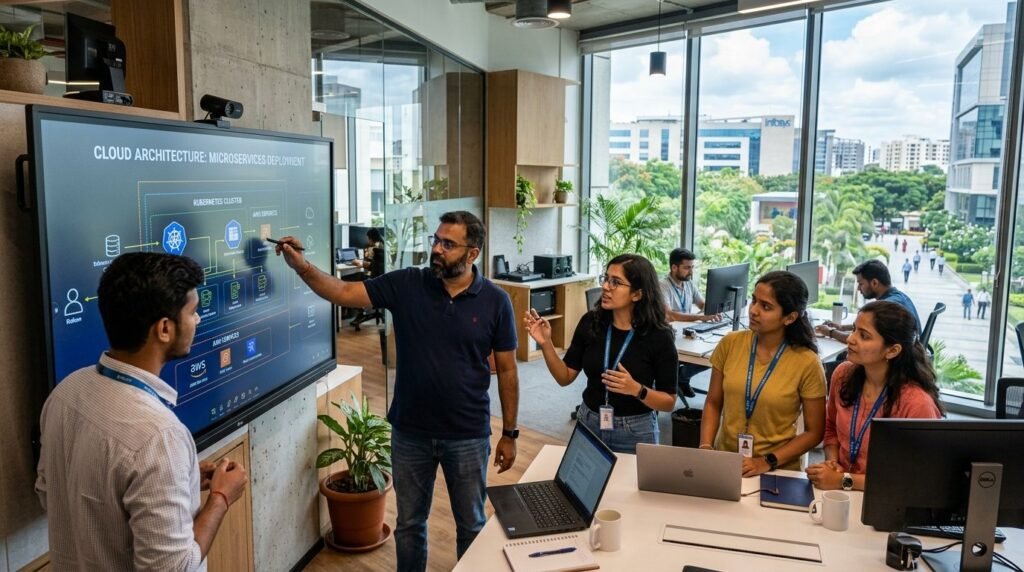
India’s Information Technology (IT) services industry is one of the most powerful economic engines in the world. Generating over \$250 billion in annual revenue and employing more than 5.4 million professionals, global giants like Tata Consultancy Services (TCS), Infosys, Wipro, HCLTech, Cognizant, LTIMindtree, and Accenture India form the technological backbone of global banking, aerospace, retail, and healthcare enterprises.
Yet, for millions of young engineering graduates entering this vast corporate ecosystem, the internal hierarchy can feel opaque. Questions like “What is the difference between a Systems Engineer and a Tech Lead?”, “Should I pursue an architectural track or a project management track?”, and “How do I grow from a ₹3.6 LPA starting package to a ₹30+ LPA leadership compensation?” are common across campuses in Bengaluru, Pune, Hyderabad, and Chennai.
Following our popular guides on Top 50 HR Interview Questions and Answers and Understanding CTC vs In-Hand Salary, this comprehensive roadmap charts the entire 6-stage career hierarchy ladder in Indian IT services, compares technical interview expectations vs management trajectories, outlines must-have 2026 skill stacks, and reveals proven strategies for rapid promotion.
1. The 6-Stage IT Services Hierarchy Ladder (From Trainee to VP)
While organizational job titles vary slightly across TCS, Infosys, and Cognizant, the functional hierarchy across Indian IT services adheres to a standard 6-stage operational ladder:
🏢 THE 6 STAGES OF THE INDIAN IT CAREER LADDER:
Stage 1 (0–2 Yrs): Trainee / Assistant System Engineer / Associate (₹3.6–₹5.5 LPA)
Stage 2 (2–5 Yrs): Software Engineer / Senior Software Engineer (₹6.5–₹12 LPA)
Stage 3 (5–8 Yrs): Module Lead / Technical Lead / Scrum Master (₹12–₹18 LPA)
Stage 4 (8–12 Yrs): Solution Architect OR Project Delivery Manager (₹18–₹28 LPA)
Stage 5 (12–18 Yrs): Senior Enterprise Architect OR Program Delivery Director (₹28–₹45 LPA)
Stage 6 (18+ Yrs): Vice President / Practice Head / Chief Technology Officer (₹50 LPA – ₹1 Crore+)
Stage 1: The Foundation Phase (0–2 Years Experience)
Designations: Assistant System Engineer Trainee (TCS), Systems Engineer (Infosys), Project Engineer (Wipro), Programmer Analyst Trainee (Cognizant).
Compensation Benchmark: ₹3.6 LPA to ₹5.5 LPA (Entry-level) | ₹6.5 LPA to ₹9.5 LPA (Specialized tracks like TCS Digital or Infosys Specialist).
Core Deliverables: Your first 18 to 24 months are dedicated to absorbing enterprise software development lifecycles (SDLC). You undergo corporate induction training, learn client coding standards, write automated unit tests, resolve minor Jira bug tickets, and participate in daily agile standup calls. Success at this stage is defined by zero defect leakage, prompt attendance, and rapid learning agility.

Stage 2: Core Engineering & Module Ownership (2–5 Years Experience)
Designations: Software Engineer, Senior Software Engineer, Associate Consultant.
Compensation Benchmark: ₹6.5 LPA to ₹12 LPA.
Core Deliverables: You transition from executing supervised tasks to taking full end-to-end ownership of software modules. You design relational and NoSQL database schemas, build secure RESTful APIs, configure CI/CD deployment pipelines, and conduct peer code reviews. At this milestone, high performers build a reputation as the “go-to debugger” for production incidents.
Stage 3: Technical Leadership & Mentorship (5–8 Years Experience)
Designations: Module Lead, Technical Lead (Tech Lead), Team Lead.
Compensation Benchmark: ₹12 LPA to ₹18 LPA.
Core Deliverables: As a Tech Lead, you guide a squad of 4 to 8 junior developers. You translate high-level client business requirements into granular technical sprint stories, estimate development effort, enforce security standards (OWASP), and interface directly with overseas client technical managers during sprint reviews. You balance hands-on architecture with peer coaching.
2. The Critical Fork: Technical Track vs Management Track
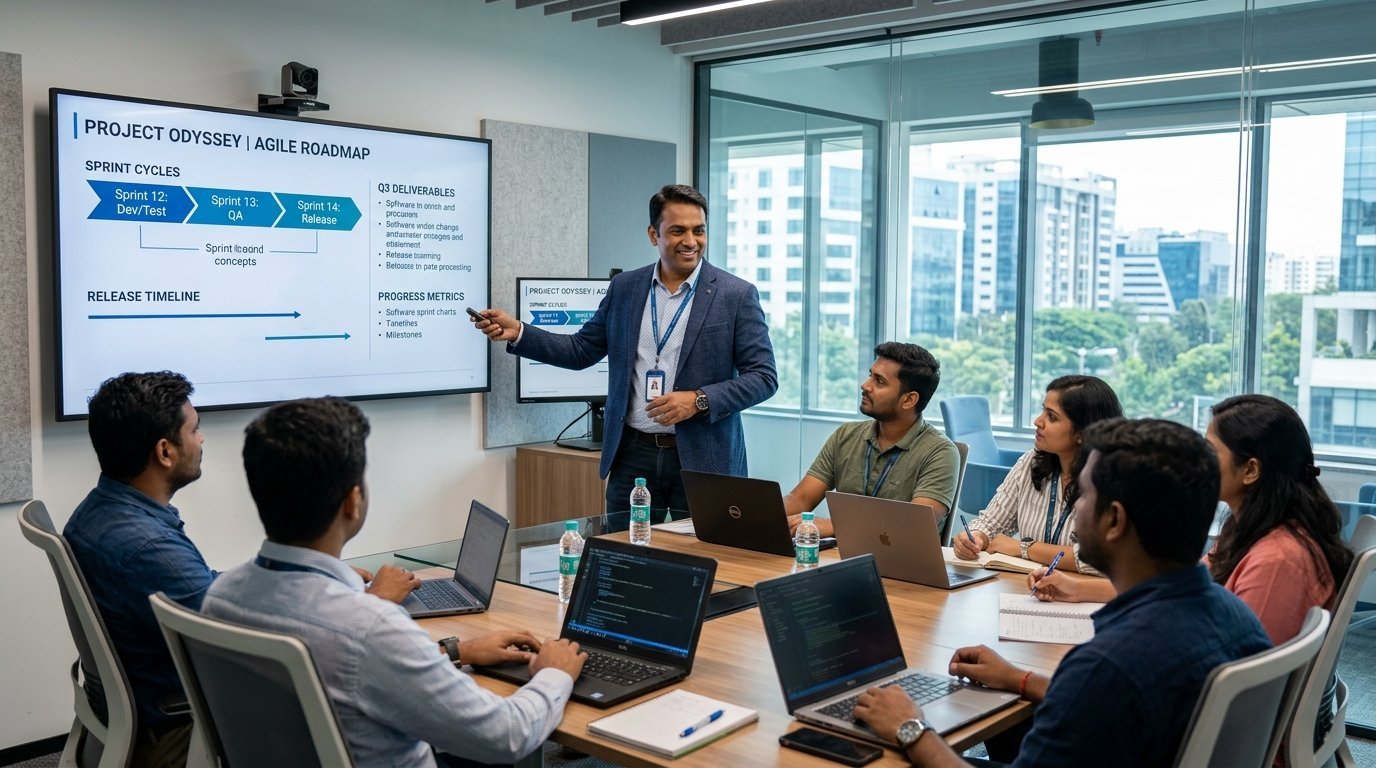
Around your 7th to 8th year in Indian IT services, every engineer arrives at a career crossroads. You must consciously choose between two parallel paths based on your strengths and professional ambitions:
| Evaluation Factor | Technical / Architectural Track | Management / Delivery Track |
|---|---|---|
| Typical Roles | Solution Architect, Cloud Architect, Enterprise Architect, Fellow | Project Manager, Scrum Master, Delivery Manager, Program Director |
| Core Responsibility | Designing scalable, resilient system architecture, cloud migration, security compliance | Resource allocation, budget P&L, client billing, on-time delivery, SLA adherence |
| Daily Tools | AWS/Azure Consoles, Kubernetes, Kafka, Terraform, Lucidchart, GitHub | Jira, MS Project, Confluence, Power BI dashboards, Excel financial models |
| Key Credentials | AWS Solutions Architect Pro, TOGAF, CKA (Kubernetes), Google Cloud Fellow | PMP (Project Management Professional), PMI-ACP, CSM, Executive MBA |
| Compensation Potential | ₹25 LPA to ₹50+ LPA (High global market liquidity) | ₹22 LPA to ₹45+ LPA (Tied to account revenue size) |
3. Critical Skill Stacks That Accelerate Promotion in 2026
The era of manual software testing and repetitive maintenance is declining. To advance rapidly through the IT services ladder, focus on these four non-negotiable skill pillars:
1. Cloud Native Architectures (AWS, Azure, GCP)
Modern enterprise clients are shuttering physical data centers. Mastering serverless functions (AWS Lambda), container orchestration (Kubernetes/EKS), infrastructure as code (Terraform), and microservices event streaming (Apache Kafka) positions you for high-margin digital transformation projects.
2. Enterprise Generative AI & Copilot Integration
Indian IT service leaders are measuring engineering velocity through AI-augmented workflows. Understanding how to integrate Large Language Model APIs (LangChain, vector databases like Pinecone), automate testing with GitHub Copilot, and build secure private enterprise retrieval systems makes you indispensable to account delivery managers.
3. Client-Facing Communication & Cross-Cultural Fluency
Technical brilliance without clear communication stalls career progress at the 5-year mark. Engineers who can explain technical trade-offs calmly to non-technical client stakeholders in the US, Europe, and Australia are fast-tracked into architectural and lead positions.
4. How to Escape the “Support Project Trap” in Indian IT
One of the most frequent complaints among freshers joining Indian IT services is being allocated to legacy application support or L1/L2 incident maintenance. Follow this 3-step strategy to transition into core development:
- Automate Your Daily Maintenance Tasks: Write Python scripts, SQL procedures, or Bash shell scripts that automate routine log checks, ticket routing, and report generation. Present your automation to your delivery manager as an efficiency saving.
- Clear Internal Premium Digital Exams: Programs like TCS Wings / Elevate or Infosys Power Programmer allow employees to sit for rigorous internal coding and architecture exams. Clearing them triggers immediate grade elevations and project reallocation.
- Leverage the Internal Job Posting (IJP) System: Every IT firm maintains an internal career portal where delivery managers recruit for new client projects. After completing 12 to 18 months in your base account with clean performance ratings, apply for IJP openings in cloud and data engineering.
Frequently Asked Questions (FAQ): IT Services Career Roadmap
1. What is the typical career progression ladder in Indian IT services companies?
The standard career hierarchy in Indian IT services follows 6 stages: 1. Assistant System Engineer / Trainee (0-2 years), 2. Software Engineer / Senior Software Engineer (2-5 years), 3. Technical Lead / Module Lead (5-8 years), 4. Technical Architect or Project Manager (8-12 years), 5. Senior Architect or Delivery Director (12-18 years), and 6. Vice President / Practice Head (18+ years).
2. How can a fresher move from a support project to a development project in TCS or Infosys?
Acquire verified certifications in high-demand technologies (AWS, Azure, Java Spring Boot, React), clear internal digital upskilling assessments (like TCS Elevate/Wings or Infosys Power Programmer), and apply for internal project transfers through the company Internal Job Posting (IJP) portal.
3. What is the difference between the Technical Track and the Management Track in IT services?
Around the 7-8 year mark, engineers choose between two parallel paths: The Technical Track (Technical Lead -> Solution Architect -> Chief Enterprise Architect) focuses on deep system design and coding; the Management Track (Scrum Master -> Project Manager -> Delivery Director) focuses on budget, client delivery timelines, and people management.
4. What is the average salary growth in Indian IT services over 10 years?
An entry-level IT services engineer starting at ₹3.6 to ₹4.5 LPA can grow to ₹7-10 LPA by year 4, ₹14-18 LPA by year 7, and ₹22-30+ LPA by year 10, particularly if they execute 1-2 strategic lateral switches and acquire specialized cloud or architecture skills.
5. What does being ‘on the bench’ mean, and how should freshers utilize this time?
The ‘bench’ is a period when an employee is between billable client projects while still drawing their base salary. High-performing professionals use bench time to complete paid corporate certifications, build internal proof-of-concept (POC) applications, and network with delivery managers for upcoming premium client accounts.
6. How does the bell curve appraisal system work in Indian IT companies?
In a traditional bell curve, employees are categorized into performance buckets: Top Performers (10-15% receiving highest rating and 12-20% increments), Average Performers (70-75% receiving 6-9% increments), and Low Performers (10-15% placed on performance improvement plans). High billability and certification completion are key to securing top ratings.
7. Are Global Capability Centers (GCCs) better than IT Services companies in India?
GCCs (in-house tech centers of global Fortune 500 banks, retail, and healthcare brands in India) generally offer 30-50% higher compensation and direct ownership of business products. However, IT services companies provide broader domain exposure across multiple global clients early in one’s career.
8. Which technical skills offer the fastest promotions in IT services in 2026?
Cloud Architecture (AWS/Azure/GCP), DevOps & Site Reliability Engineering (Kubernetes, Terraform), Data Engineering (PySpark, Snowflake, Databricks), and Generative AI enterprise integration currently yield the fastest career advancement and client deployment.
9. How frequently should a software engineer switch companies in India for optimal growth?
Industry experts recommend staying at your first company for at least 2 to 2.5 years to build solid project domain depth, followed by strategic switches every 3 to 4 years. Chronic hopping under 12 months damages resume credibility during senior technical evaluations.
10. How can I negotiate a higher starting package when joining an IT services firm?
For freshers, qualify through premium hiring tracks (such as TCS Digital/Prime, Infosys DSE/Specialist, or Wipro Turbo). For lateral hires, showcase niche certifications and multiple competing offers. Refer to our CTC vs In-Hand Salary Guide for detailed negotiation math.
Explore Related Career & Placement Guides on PrivateNaukriOnline:
Campus & Off-Campus Aptitude Test Guide
Master Quantitative math shortcuts, Logical puzzles, Verbal ability, and company-specific patterns.
Employment Bonds, Notice Period & BGV Rules
Understand legal enforceability, certificate retention laws, and background verification rights in India.
How to Negotiate Your Salary Offer Letter
Word-for-word counter-offer email templates, fixed vs variable tips, and joining bonus negotiation tactics.
Average Fresher Salaries Across Indian Sectors
Realistic salary benchmarks for engineering, science, and commerce freshers across IT, BFSI, and manufacturing.
👉 Recommended Career Guides in This Series
Plan your technical career trajectory with our linked pillar resources:
Understanding CTC vs In-Hand Salary in India
Calculate take-home pay, 12% PF retirement deductions, and tax slabs from entry-level to architect tier.
Top 50 Common HR Interview Questions & Answers
Master behavioral questions using the STAR framework for TCS, Infosys, and corporate hiring rounds.
ATS-Friendly Resume Guide for Indian Job Seekers
Format clean, single-column resumes engineered to pass automated corporate applicant tracking systems.
Banking & Financial Services (BFSI) Careers in India
Explore private banking eligibility, retail vs investment roles, entry certifications, and salary ladders.